|
Galapagos Total Solar Eclipse Cruise-tour With Special Guests: |
[ Tour Overview ] [ Eclipse Circumstances ] [ About the Ship ] [ Full Itinerary ] [ Costs & Terms ] [ About Galpagos ] [ Special Guests ]
[ BUCHUNGSANFRAGE ]
March 31 LD
Arrival Galpagos in Baltra - After arriving via a morning flight to Baltra Island in the Galpagos, board your expedition ship, the M/V Galpagos Legend. Aboard the Galapagos Legend you'll discover a volcanic island paradise situated directly on the equator 500 miles west of the Ecuadorian coast. Enjoy up-close interaction with indigenous wildlife, marine animals, flora and fauna with a focus on natural history throughout the Galapagos Legend boat trip. The Galapagos Legend is the fastest stabilized boat in the islands with all the amenities of a cruise liner
PM Bartolome - A very impressive little island in front of Sullivan Bay, with a landscape of real volcanic desolation: tuff cones, spatter cones, scoria formations and black volcanic sand. On the north beach, the Pinnacle Rock stands like a finger pointed to the sky. Under the rock, underwater life is attractive with Galpagos penguins, blue nudibranchs, stingrays, whitetip and blacktip sharks, an occasional spotted eagle ray or black turtles.April 01 BLD
AM El Barranco Genovesa (Tower) After a dry landing, one climbs up 25 meters through a barranco and reaches the arid zone of palo santos, where great frigates nest in the trees and Nazca boobies on the ground. The trail heads inland to the east coast and an old pahoehoe lava flow, now reddish brown due to oxiation and erosion. Storm petrels swarm by the hundreds. Short-eared owls hide in the crack of the lava flow and prey on the petrels.
PM Darwin Bay Genovesa (Tower) - One disembarks on a small white coral beach behind a lava ridge bordering the bay. Night and lava herons, looking for small fry are common. Sea lions come to have a swim there at all times and the trail leads onto the cliff. Swallowtail gulls make nests of white coral and black volcanic gravel, where they lay their speckled eggs. Opuntia cacti are everywhere. Red-footed boobies, gulls and frigates hover over the cliff overlooking the bay in the rising winds.
April 02 BLD
AM Puerto Egas (Santiago) - The island is currently uninhabited. James Bay or Puerto Egas on the west coast of Santiago, with a black sand beach and small cliffs of tuff formations, was once colonized by man. The remains of some buildings still stand on the cliff. With a climb, visitors are rewarded to a spectacular view of two craters of tuff cones and the panorama of the bay. An easier walk is to the grottos, basaltic marine caves with open roof, on the littoral. These natural pools are an enchanting place, where sea lions and fur sea lions come to play. Shorebirds are numerous, including 10 species of the Darwin Finches as well as the Galpagos Hawk, lava herons, oystercatchers, whimbrels, semipalmated plovers and wandering tattlers. Zayapas, red and turquoise blue crabs are everywhere. Galpagos doves are also common in the area. Puerto Egas is the best site in the Archipelago to watch the Galpagos Fur Seal. Visitors may also enjoy snorkeling and swimming.
PM Rabida - Rabida is more volcanically diversified than any other island of the Galpagos. Vegetation is composed of palo santos, opuntias and spiny shrubs. Behind the red sand beach to the north, a brackish lagoon shelters a population of flamingos, Bahama pintail ducks and common stilts. Pelicans nest by the beach in the salt bushes. Blue-footed boobies and Nazca boobies are found in the cliffs. A new trail leads to the top of a small hill where portions of the purple-red cliff crumble into the sea.April 03 BLD
AM Punta Espinoza (Fernandina) - Set on the Bolivar Channel on Fernandina island, Punta Espinosa is home to occasional Galpagos Penguins and flightless cormorants. The site of Punta Espinosa is home to a colony of sea lions and marine iguanas. Red and turquoise-blue crabs, zayapas are everywhere. The Galpagos hawk is also common on the site, where it preys on snakes and marine iguanas.
PM Caleta Tagus (Isabela) -This small, U-shaped cove was refuge for pirates and whalers. It is still a historical site. Behind the cove, a stairway leads to a viewpoint overlooking Darwin Lake. The brackish lagoon is home to white palo santos who turn happily green during the wet season. Darwin finches are also found in swarms. Further hiking will reveal the silhouette of Ecuador and Wolf volcanoes. It is possible to take an optional ride along the cliffs to observe pelican nests, blue-footed boobies, noddy terns in a marine cave, Galpagos penguins, marine iguanas and lazy sea lions. Snorkelling and skin diving are interesting here as well.
April 04-07 BLD
Sailing to the site - starting at 00:00 on April 04.
The eclipse path in its total phase will not intersect land at any point. We will traverse 1100 km to intersect the path at an optimum viewing location directly west of the Galpagos Archipelago. Arrival to the site around 20:00 on April 07.
April 08
Observing the eclipse
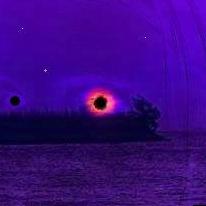
The
Hybrid Solar Eclipse is a rare occurrence indeed, perhaps only as often
as five times in a century. Here, the moon will be positioned at a
distance where its apparent size is only .0067% larger than the Sun.
This means that at the beginning and end of the eclipse path, the moon
will not fully cover the sun. Our journey will take us to the narrow
intercept point inside the path of totality, where we will experience a
very spectacular shallow total eclipse. We will expect to see an
extraordinary volume of bright white Baily's Beads, dancing before and
after the brief 34-second display of totality. As the moon covers even
less of the sun's disk, more of the innermost chromosphere is visible
to the naked-eye beyond the limb of the moon. The event should also
bring a brilliant display of ruby red prominences of the chromosphere
surrounding the edge of the moon throughout.
April 08-12 BLD
Sailing to the Galpagos
April 12 BLD
Puerto Villamil (Isabela) - One of the least inhabited islands, Isabela has a population of about 1800 people and an 'end of the world' feeling. It is home to a circa 1897 fishing village with a historical past rich in fabulous and terrible stories including pirates and buried treasure hidden there. It is one of the most beautiful sites of the archipelago with white sand beaches that stretch for kilometers. Behind Villamil, brackish lagoons are refuge for flamingos, whimbrels, white-cheeked pintails, common stilts and gallinules. Snorkeling is an option, a short walk takes you to Poza de la Concha Perla, next to the Embarcadero, its reef formation and marine life are truly fascinating.
April 13 BLD
AM Cerro Dragon (Santa Cruz) - Cerro Dragon is home to a brackish lagoon, where the ocean water seeps through the sand, and some is evaporated resulting in hypersalinic water. Here, there is a lushness, even during the dry season when the palo santo trees are brown and leafless, unlike the barren patches of frozen lava. Small rocky islets are home to pelicans and blue-footed boobies that cover the black lava in white guano. Candelabra cacti adorn these pockets of land. We see the blue-foots in brilliant action here as they dive for fish in the water. The boobies seem to pull their bodies into a perfect torpedo shape, barely leaving a splash behind as they breach the surface.
PM Seymour - North of Baltra, Seymour is a small flat island with a land surface of two square kilometers. Palo santos are endemic to the island. Opuntia, the local prickly pear cactus is the food of the land iguanas. A trail makes a loop to the southwest, inland along the rocky coast to cross the colony of blue-footed boobies and magnificent frigates. The two nesting areas mix together, with the two species sharing a habitat in harmony. A few marine iguanas walk across the white coral sand, leaving tracks with their tail and claws. Sea lions bask on the black lava rocks, and the surf crashes on the rocky shore of the west coast at sunset.
April 14:
Baltra airport for departure to Quito or Guayaquil
Includes:
Excludes:
* All prices in USD, based on double occupancy are accurate at time of printing (Jan 20 ,2004), are subject to change until held by 20% deposit and/or required payment schedule.
[ Tour Overview ] [ Eclipse Circumstances ] [ About the Ship ] [ Full Itinerary ] [ Costs & Terms ] [ About Galpagos ] [ Special Guests ]
[ BUCHUNGSANFRAGE ]